
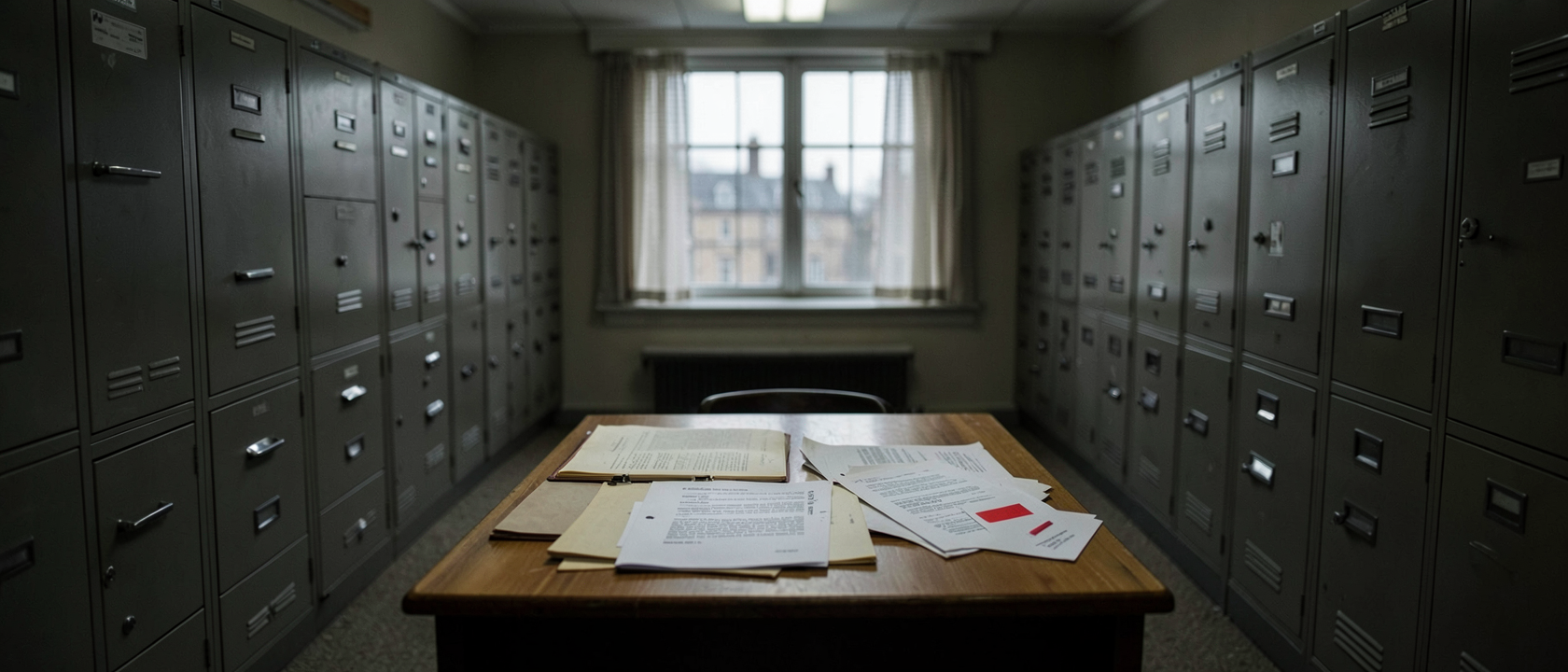
The National Archives has no way of knowing whether the women named in its infanticide case files are still alive. It has never checked. That admission sits inside a 2024 discussion paper about a policy that sounds simple: keep a defendant’s name out of public view until she is presumed dead. The paper turns out to be more revealing about its own gaps than about the women it describes.
Infanticide, in English law, is a narrow charge: a mother accused of killing her own child under twelve months old, whose mind was disturbed by childbirth or lactation, with only women eligible to be charged under it. The offense was created by the Infanticide Act 1922 and given its current wording by the Infanticide Act 1938, which received royal assent on June 23, 1938.
The paper on the table
On February 7, 2024, the National Archives’ Cataloguing Panel met to review its policy on naming defendants in closed infanticide files. The discussion paper prepared for that meeting has its author line redacted under section 40(2) of the UK Freedom of Information Act, the exemption covering personal data about an identifiable individual. Internal cross-references identify the writer as the Head of Archival Practice and Data Curation, who also chairs the panel.
The paper exists because a Quality Manager escalated a complaint from a member of the public who had asked why names were withheld from infanticide file descriptions, was unsatisfied with the Archives’ standard “Your Views” response, and requested a formal review. What resulted is a briefing for a decision-making body, laying out background and options, not a policy statement in itself.
What the policy actually says
As the paper sets it out, closed infanticide files are cataloged with the defendant’s name replaced by a bracketed placeholder, “[name withheld].” The full description is kept in a restricted internal copy the Archives calls the Closed Master, available only to limited staff. The working assumption is that a woman charged with or convicted of infanticide may still be alive up to 100 years after the date of the last paper in her file.
One such entry, held at Kew under reference C5781511, is titled “Murder: [name withheld] (infanticide).” It is closed for 100 years and will not open until January 1, 2058.
The paper frames this as an exception, not a rule of its own. Criminal case files are normally cataloged by the defendant’s name, open or closed, under guidance agreed with the Ministry of Justice and the Crown Prosecution Service. Infanticide sits outside that default.
How the policy got here
The record shows a sequence of committee approvals. In 2018, a staff member of the Archives’ FOI Centre reviewed closure status and name-withholding across infanticide files; the Reclosure Panel and the Takedown Panel both approved the result. In 2020, the Cataloguing Panel endorsed a standard note, now attached to files from roughly the past century, stating that naming a defendant does not imply guilt; it appears on CRIM 1/691, a 1934 file for a defendant named Eileen May Haynes. In November 2021, the Executive Team signed off on the general approach to cataloging criminal case files, described as aligned with Ministry of Justice and CPS guidance.
The reason given
The paper’s stated rationale is specific: an infanticide charge is, by definition, a statement about the defendant’s mental health, since it requires a finding that her mind was disturbed by childbirth or lactation. The Archives treats that as sensitive personal data that should not be published while she may still be alive.
That logic is not applied anywhere else in the paper. It lists the infanticide exception alongside three others: juvenile defendants, parties to incest cases (to protect a victim who is also a relative), and men convicted of sexual offenses since decriminalized. It does not explain what connects these categories, or why a charge like rape, which raises comparable questions about a defendant’s conduct and mental state, is treated differently.
What the minutes don’t say
The released version of the paper does not record an outcome from the February 7, 2024 meeting: no vote, no stated decision, no noted deferral. That is a gap in the paperwork as released, not evidence of what the panel concluded. Minutes are sometimes kept separately from a discussion paper, and none have surfaced in this release. The document, as it stands, stops at the question, not the answer.
The question the paper never asks
Nowhere does the Archives explain why this protection applies only to women charged with infanticide, an offense that by definition can only be brought against a woman, when other charges raise comparable sensitivities about mental health regardless of sex. Rape was the exact comparison the complainant raised; the paper lists its other name-withholding exceptions side by side without drawing it. Nor does it describe a dedicated process for a member of the public to contest the withholding of a name in one specific file, beyond the general FOI and review channels available for any record.
Nobody is checking
The Archives does not record defendants’ dates of birth and does not cross-check death registers. A name is not restored because a death has been confirmed; it is restored only when the closure period itself expires, typically 75 to 100 years after the last paper in the file, a span the paper admits “may be significantly longer than the defendant’s anticipated lifetime.” A file closed for 75 years under reference ASSI 88/106, for a 1954 case, will not open until 2029, regardless of when the woman named in it actually died. The schedule runs on paperwork, not on a life.
What the complainant said
The complainant made three arguments, as the paper reports them: that there is no reasonable justification for withholding the names; that doing so is deliberately sexist, protecting women while naming men accused of offenses as serious or less so, including rape; and that it unreasonably blocks researchers from parts of the Archives’ collections. These are his claims, not a finding reached by the Archives. The paper neither confirms nor formally rebuts them, and no Archives response survives in what has been released. What remains on the record is the paper itself: a chronology of approvals, a rationale that covers one case and stops short of the next, and a meeting whose outcome was never written down.