
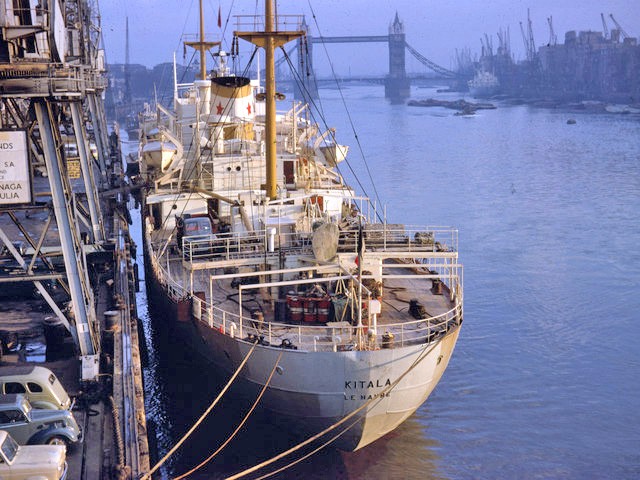
The Port of London is the port complex along the banks of the River Thames in Essex, Kent and Greater London. It grew from a scattering of rival private docks into one of the busiest ports of the British Empire, with wharves and docks receiving about 7.5 million tons of cargo each by 1900. Control passed in 1909 to a single public body, the Port of London Authority, and cargo volumes later peaked at 44.6 million tons in 1938 before the trade moved downriver. As of the PLA’s most recent figures cited in 2024, the port still handles over 50 million tonnes of cargo a year and carried an estimated 9 million passengers on the river in 2023.
Key facts
- Country: United Kingdom
- Type: port; inland port; seaport
- Located in: Essex; Kent; Greater London
- Coordinates: 51.5000, 0.0500
Rival docks and a single authority
The enclosed docks on the tidal Thames were built by several competing private companies, notably the East & West India Docks Company, the Surrey Commercial Docks Company and the London & St Katharine Docks Company. Each operated its own basins and warehouses, with no single body coordinating the river as a whole.
The creation of a unified Port of London Authority was first proposed in the King’s Speech at the Opening of Parliament in November 1903. The Port of London Act followed in December 1908, passed despite opposition, with the final acquisition of the docks concluded under Winston Churchill at the Board of Trade. The new Authority took over the assets of the dock companies, including the Surrey Commercial Dock Company, the London & India Dock Company and the Millwall Dock Company, at a cost of £23 million, around £2.2 billion in 2024 money.
The PLA began operating in March 1909, accountable to the Board of Trade. In its first full year, 1910, 18.6 million tons of foreign and coastwise cargo passed through London. The Authority later built the King George V Dock, construction starting in 1912.
Rise, peak and closure of the enclosed docks
Cargo tonnage through the Port climbed through the early twentieth century and reached a pre-war peak of 44.6 million tons in 1938. Changes in cargo handling technology and the growth in ship size then made the up-river enclosed docks, from St Katharine’s to the Royal Docks, increasingly unworkable, and they closed in stages between 1967 and 1981 as trade shifted downriver toward deeper water.
Tilbury Docks was privatised in 1992, which marked the end of the PLA’s direct involvement in handling cargo itself.
Modern operations
The Port of London handles over 50 million tonnes of cargo a year. The larger, privately-owned operations are concentrated around and down river of the Queen Elizabeth II crossing at Dartford and Purfleet-on-Thames, rather than in the old up-river docks. In its most recent Annual Report and Accounts cited in 2024, the PLA estimated that 9 million passengers travelled on the river in 2023.
The tidal Thames through the Port of London is crossed by 28 bridges between the estuary and Teddington, among them Tower Bridge. London is home to four UNESCO World Heritage Sites, all connected to the river.
A £1 billion expansion of London Gateway began construction in May 2025, adding two 400-metre all-electric berths and a second rail terminal. Completion is projected to take four years from that start.
Did you know
- The Port of London was long the largest dock complex in the world, with a storage capacity of one million tons; in 1899 over nine million tons of foreign cargo passed through it, a third of all goods arriving in the country. (erenow.org)
- London’s standing as the world’s largest port lasted until around 1913, when it was overtaken by Hamburg and then New York. (erenow.org)
- In the PLA’s first full operating year, almost 10,000 vessels used its docks while handling 18.6 million tonnes of cargo. (ship.nridigital.com)
- The number of PLA dockworkers rose to over 13,000 by 1911, staying fairly constant until after the Second World War. (thehistoryoflondon.co.uk)
- Over 1,000 people worked in the PLA’s headquarters and dock offices, alongside more than 7,000 permanently employed dock workers and an average of around 3,000 casual labourers hired each day. (thehistoryoflondon.co.uk)
- Quebec Dock, built 1922-6 in the Surrey Commercial Docks, had 15 acres of water, a depth of 27 feet, and four large timber storage sheds alongside. (gracesguide.co.uk)
- London Gateway only began operations in November 2013 yet is on track to become the UK’s largest container port, with throughput growing 52 percent in 2025 alone. (maritime-executive.com)
- Once its expansion is complete, London Gateway’s berths will accommodate six of the world’s largest container ships, served by Europe’s tallest quay cranes. (newcivilengineer.com)
Data sources
Where it appears
- Chaucer’s Wine Grant (C 81/456): Edward III’s Reason Left Unrecorded November 20, 2026
Data updated: 2026-11-17