
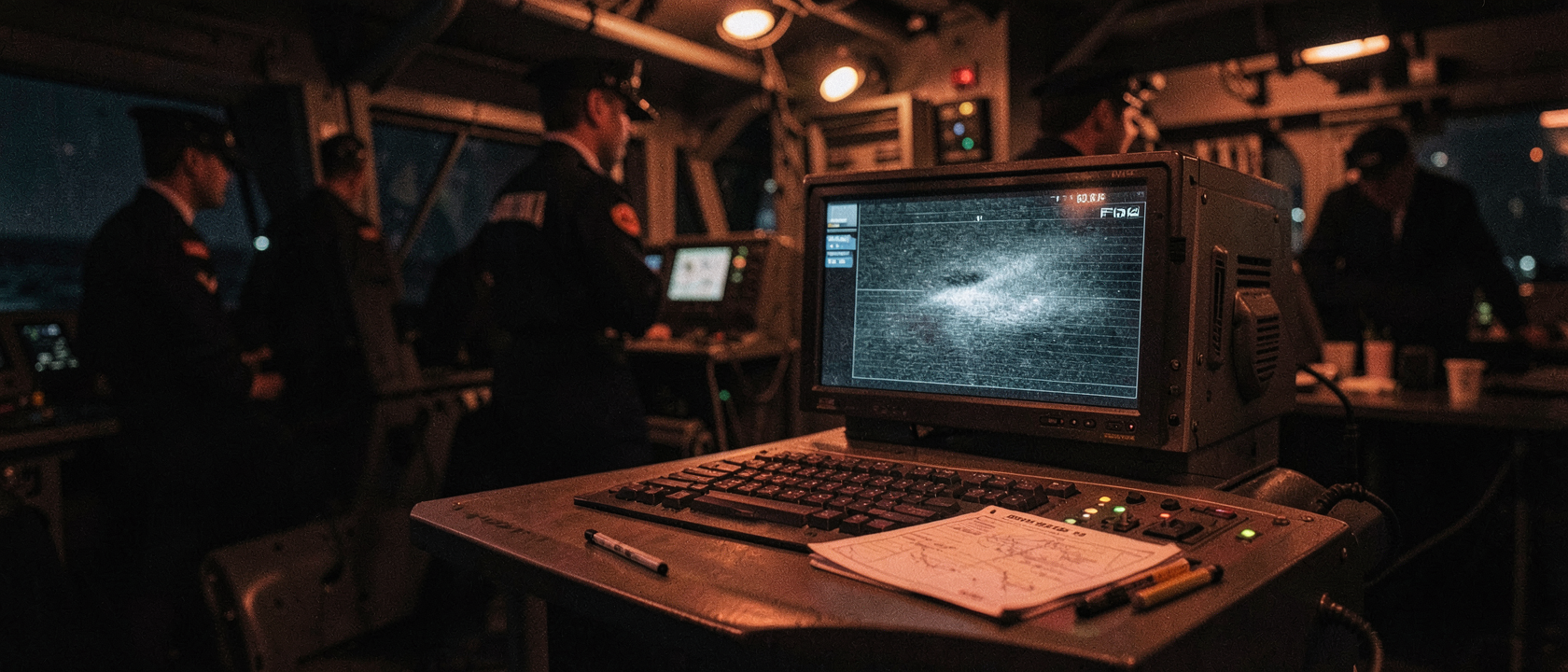
In July 2019, several U.S. Navy destroyers operating in training areas off San Diego recorded recurring encounters with aerial drones. The matter became public knowledge partly through filmmaker Dave Beaty in July 2019, and drew wider attention in April 2021 when filmmaker Jeremy Corbell posted night-vision footage showing what he described as pyramid-shaped objects over the USS Russell. That leak prompted a Freedom of Information Act effort to secure the ships’ actual logs. What the Navy released in January 2022 was a batch of raw watchstander paperwork, a single briefing slide, and an isolated photograph whose origin the service had not initially clarified.
The Paperwork Arrives via Appeal
John Greenewald Jr., creator of the public records archive The Black Vault, asked the Navy for all deck logs from the Arleigh Burke-class destroyer USS Russell (DDG-59) covering July 2019, along with any related memos, reports, images, or video. The service’s first production omitted the Russell’s logs. Greenewald appealed, challenging the omission and noting that a single timeline slide and one degraded still were an implausible record for events that had prompted fleet-level concern.
The Navy granted that portion of the appeal.
On January 27, 2022, Greenewald received 381 pages of unclassified deck logs spanning the full month of July 2019, a 60-megabyte file. Included was a degraded black-and-white still labeled as a forward-looking infrared (FLIR) capture, alongside an intelligence slide previously published by the defense outlet The War Zone. Greenewald telephoned the Navy’s FOIA case officer that day seeking basic context for the image. On February 1, 2022, the Navy confirmed that the image had not been recorded aboard the Russell at all. It was captured from a sister destroyer, the USS Paul Hamilton (DDG-60), on July 17, 2019.
Entries in the Deck Logs, July 2019
The logs outline an escalating series of night encounters within warning areas of the Southern California Training Range. The earliest logged event appeared on the USS Kidd around 10:00 p.m. on July 14, 2019, when crew members noted two unmanned aerial vehicles. The next night brought heavier activity: on July 15, watchstanders on the Russell recorded up to nine separate drone sightings in under an hour. In total, reports involved five destroyers: the Paul Hamilton, Kidd, John Finn, Rafael Peralta, and Russell, with crews noting up to five or six drones operating in the area.
The entries show shipboard responses shifting over the month. An admiral boarded on July 22, just ahead of counter-unmanned aerial system drills and log references to “ghostbusters” teams on the morning of July 24. Drone contacts continued late into the month. In the early hours of July 30, at least three ships logged drones, with a countermeasure team activated from 2:15 a.m. until 3:27 a.m. For that event, the Russell’s unclassified log is almost completely redacted, leaving no surviving ledger entries in that file for what transpired during the watch handoffs that followed.
Optical Hypotheses and the Briefing Slide
Corbell claimed his April 2021 footage showed objects recorded by the Russell’s crew. Department of Defense spokesperson Susan Gough subsequently confirmed that Navy personnel recorded the leaked video and images, and noted that the Pentagon’s Unidentified Aerial Phenomena Task Force had incorporated the incidents into its ongoing work. Gough stated that the Pentagon does not publicly discuss details of range incursions to protect operational security, declining to assign any label to the targets, whether unidentified, drone, or balloon.
The distinct triangular shape seen in the night-vision recording also prompted an optical explanation: an out-of-focus point of light observed through a camera with a triangular aperture produces a triangular blur, a standard bokeh artifact. Beyond optical effects, the paperwork presents its own internal gaps. The slide released by the Navy is dated July 17, yet reporting by The War Zone noted that the slide’s map aligns with incidents from July 14 and July 15. The public record does not settle whether Corbell’s video dates to the specific nights recorded in the July deck logs.
What the Record Leaves Unresolved
What the appeal produced was limited. The 381 pages consist of shift logs recording course changes, lighting status, and personnel rotations. The attached infrared still lacks basic parameters such as target speed, altitude, or classification. When The War Zone filed a follow-up request for the complete presentation behind that slide, searches by the USS Paul Hamilton, Commander Naval Surface Force Pacific, and Strike Group Nine returned no responsive records.
Local atmospheric conditions may have contributed to the image quality. Navy records show regional fog at the time, and because the Paul Hamilton was operating away from fixed weather observation stations, exact offshore conditions remain unrecorded. At the same time, the destroyer carries advanced infrared sensors, leaving unresolved whether fog alone accounts for the degraded image. The surviving deck logs close without an attached investigation report, leaving the identity and operational origin of the drones unstated in the released paperwork.