
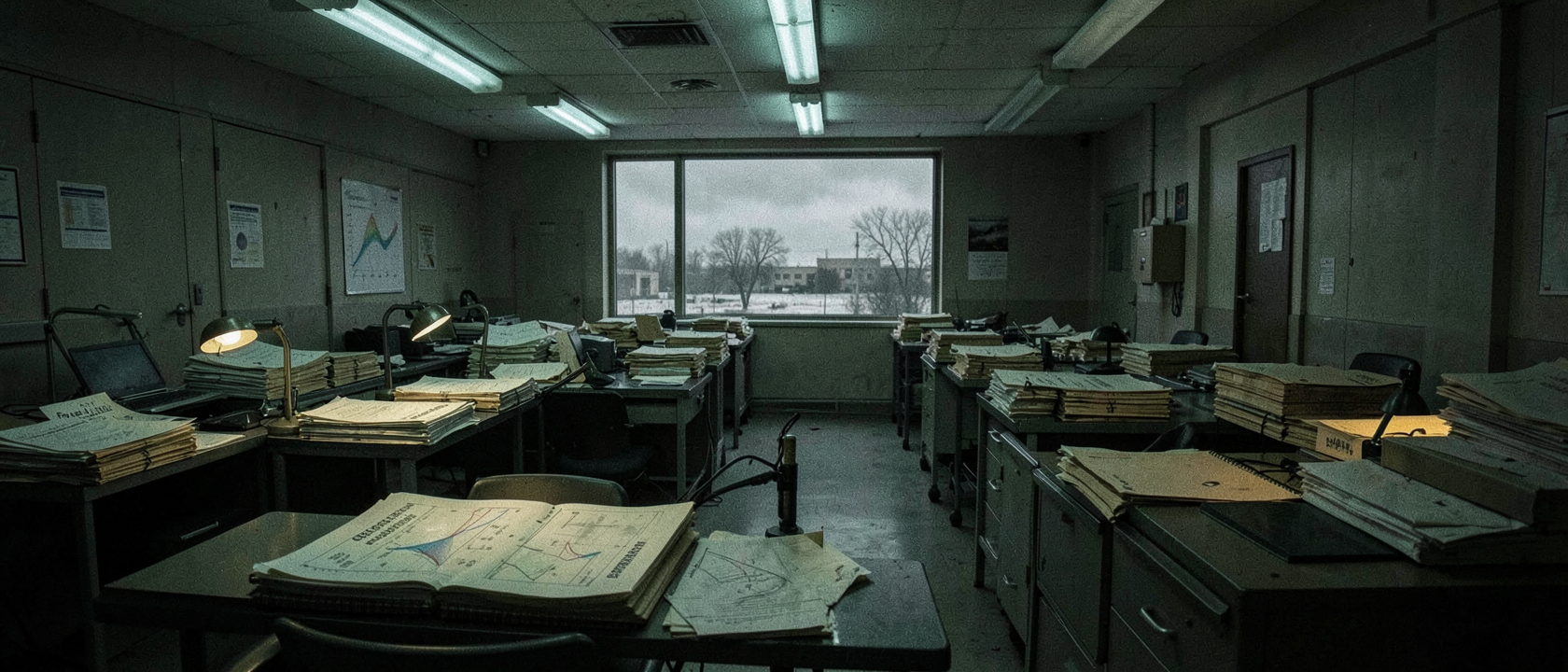
The Chart
The fourth document in a National Security Archive briefing book titled “Nuclear Winter: U.S. Government Thinking During the 1980s,” compiled by analyst William Burr and posted June 2, 2022, is a single briefing chart. It comes from the Defense Nuclear Agency‘s Atmospheric Effects Division, is titled “Global Effects of Nuclear War,” and is dated January 31, 1984, though the posting itself describes it as a February 1984 briefing. It was released unclassified under a Freedom of Information Act request, the law that lets the public request copies of government records, filed with the Defense Threat Reduction Agency, the Defense Nuclear Agency’s successor office. A briefing chart is built to be talked through in a room, not filed as a finished report. What survives in the record is the slide, not the conversation around it.
“Atmospheric Trauma”
The chart states that a large nuclear exchange would produce fires and smoke, and that soot from that smoke could build up in the troposphere, the lowest layer of the atmosphere where weather occurs, and cool it. The chart’s own phrase for this is “atmospheric trauma.” The agency’s briefing paired that description with an acknowledgment of a “serious potential for severe consequences” alongside “very large uncertainties,” and that combination is what pushed the Defense Nuclear Agency to commission further study. The agency itself had been reluctant to fund a wider research effort, according to the posting, a caution that sits comfortably next to a chart that admits it does not yet know how large the effect would be. None of this is a casualty estimate. It is a mechanism, stated plainly, with its own uncertainty attached.
The 1988 Study
Four years later, a different document enters the record: Science Panel Report No. 5, published March 1, 1988, by the Office of Science and Technology Policy, the White House’s in-house scientific advisory office. Its title is a mouthful by design: “Review of SCOPE 28 Report on Environmental Consequences of Nuclear War, Volume II: Ecological and Agricultural Effects.” SCOPE, an international scientific body, had already produced a two-volume study of nuclear war’s environmental effects without once using the phrase nuclear winter. A committee the White House had set up in 1984, the Committee on Interagency Radiation Research and Policy Coordination, assembled a task group of agricultural and meteorological experts from universities and government to check the second volume’s numbers. The task group’s conclusion, as the posting records it, was that SCOPE had if anything understated the damage: a large nuclear exchange would cause “severe disruption of production, processing, and distribution” of food. The individual experts on that task group are not named in the material released. Nothing in the record ties this review back to the 1984 chart. The two documents sit four years apart, from different offices, and nothing states they were written with each other in mind.
Reagan’s Four Words
The only sentence in this record attributable to the president himself comes from a Memorandum of Conversation dated February 14, 1984, summarizing a meeting between Reagan and Neil Kinnock, then leader of the British Labour Party and an outspoken critic of nuclear weapons. According to the memo, Kinnock raised what it calls the “widely discussed” idea of nuclear winter during an otherwise friendly exchange of positions. Reagan, the memo records, acknowledged afterward that a “nuclear winter was theoretically possible.” The memo was originally classified Secret before its later release. The fact sheet behind this piece does not specify what that classification level meant in practice, and none is asserted here. The remark itself does a narrow job: it shows the idea had reached the president and that he did not reject it outright. It does not show the administration treating it as settled science. A later Archive posting, from October 2024, described this remark and similar comments from other officials as evidence that high-level figures had “accepted” the concept as theoretically possible. That is a characterization written four decades after the memo was filed, not a phrase that appears in the memo itself.
What Isn’t Named
Set against each other, these three documents leave specific blanks. No individual name attaches to the 1988 task group, though its parent committee and the office that published its report do. No document explains whether anyone who worked on the 1988 review had seen the 1984 chart, or vice versa. There is no transcript of the Reagan-Kinnock exchange beyond the memo’s summary line. And on consequence, the record offers only a partial answer: the Pentagon’s official response, per the posting, stressed technical uncertainty and defended existing nuclear policy, and an interagency proposal to spend $50 million on nuclear winter research over five years was cut down to a few million dollars with no further commitment. That explains, in dull budgetary terms, why the research trail thins out. It does not say whether the chart’s cooling mechanism or the study’s food-system projection ever reached a targeting plan, a doctrine review, or a policy decision.
No Aftermath, No Commentary
Within this set of documents, none comments on the others. The 1984 chart does not anticipate the 1988 study. The 1988 study does not cite the chart or the Reagan exchange. The Memorandum of Conversation records an opinion traded across a table, not a government decision. The Archive returned to this material in October 2024 with a follow-up posting that added further documents, including an early overview of the Defense Nuclear Agency’s research program, but that later expansion sits outside what this particular set of records covers. What is missing here, and stays missing in these pages, is a paper trail connecting the science to a decision: whether anyone in Washington acted on the cooling mechanism described in 1984 or the food-system projection reached in 1988. The record, as released, does not say.