
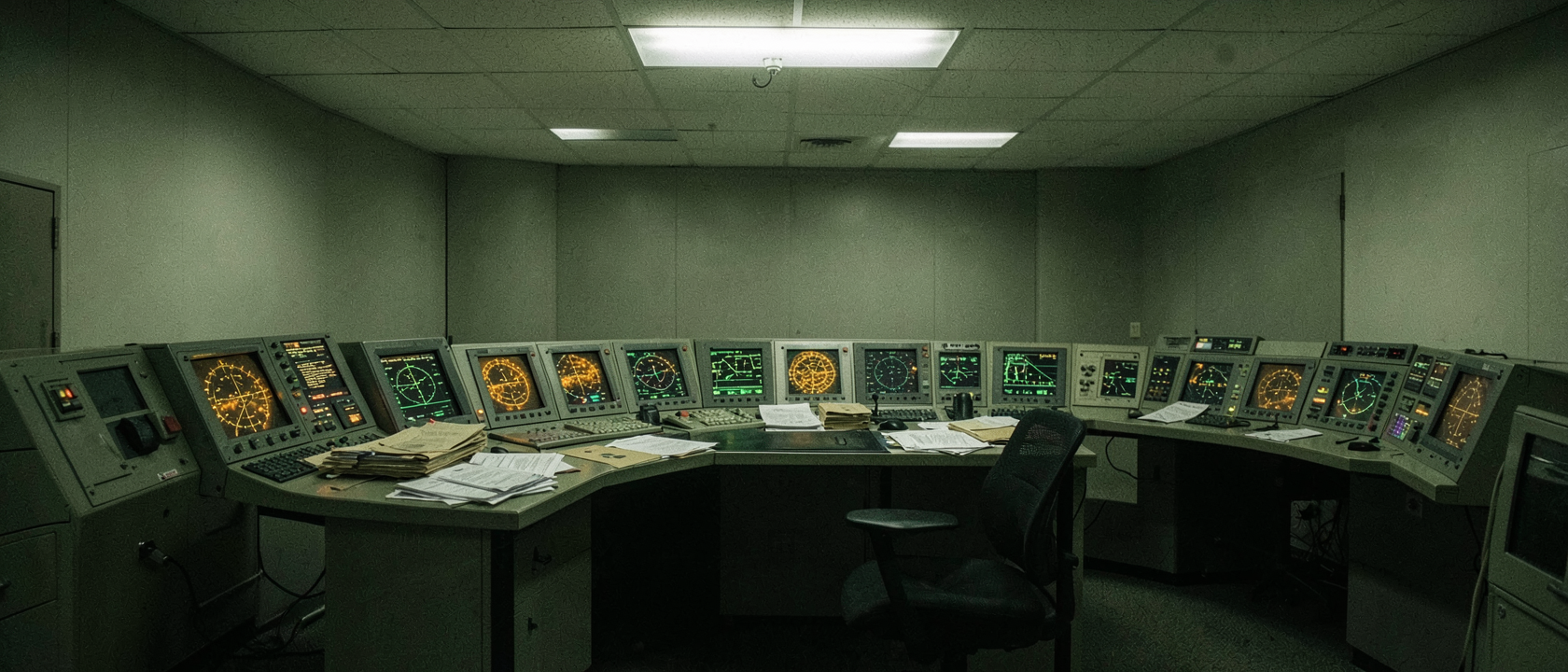
In February 2023, an FAA technical advisor wrote to a colleague about why controllers and radar operators were suddenly flagging more slow-moving objects in American skies. His explanation did not involve anything new overhead. It involved a change to the filter.
What Was Released
The Black Vault published the documents on January 10, 2025, the result of a Freedom of Information Act request filed on May 26, 2024, and logged as case 2024-04951. The request asked for any FAA emails involving Michael Freie, a technical advisor in the agency’s Air Traffic Surveillance Services Office, that contained terms such as “unidentified aerial,” “UAP,” “UFO,” or “AARO.” The FAA’s response runs 129 pages according to The Black Vault’s article text, though the document archive listing on the same site gives the page count as 131. That discrepancy sits in the primary source itself and is not resolved here. Named correspondents in the release include Freie, Amy Gusky, Warren Randolph, and Karlin Toner, all FAA staff. Some passages are withheld under Exemption 3, covering material protected by a separate statute; Exemption 5, the deliberative-process privilege that shields pre-decisional internal discussion; and Exemption 6, personal privacy. Redaction codes marked (b)(6) are visible on several pages. No index accompanies the release explaining what sits behind those redactions.
The Balloon and the Filter
The request traces back to Freie’s appearance as a scheduled speaker at a NASA meeting. Before that, in an email dated February 13, 2023, roughly two weeks after the first reported sighting of a Chinese surveillance balloon in late January 2023, Freie described how FAA radar normally works: most tracking filters eliminate plots for targets flying below 40 to 60 knots airspeed, a threshold set to screen out birds, weather returns, and other clutter that isn’t aircraft. He wrote that the Department of Defense “adjusted those minimum speed thresholds” around that time. The email connects that adjustment directly to a subsequent increase in FAA radar detections of slow-moving objects.
The Explanation Freie Gives
Freie’s account of the 2023 spike in sightings is technical, not speculative. He attributes it to the recalibrated filter combined with heightened awareness, among controllers and the public, of what the radar was now picking up. He does not claim that more objects were actually present in the sky, only that more of what was already there became visible to the system once the threshold moved. The email also does not claim to have identified what any specific flagged object was. It explains an increase in detections, not the detections themselves.
Whose Job This Was
In a separate exchange with Gusky, Freie wrote that the Department of Defense, not the FAA, should be the one speaking publicly about national defense and UAP matters, because “that mission is theirs.” Read on its own terms, that line looks like a jurisdictional boundary rather than a technical judgment, though that reading is an inference on this writer’s part, not something the email states outright. The email does not explain why he felt that distinction needed stating, only that he made it.
Freie in Public, the Same Season
Freie spoke at NASA’s Public UAP Independent Study Team meeting on May 31, 2023, a 16-member panel chaired by David Spergel, where he presented on FAA airspace monitoring methods and their limitations. Sean Kirkpatrick, then director of the Pentagon’s All-domain Anomaly Resolution Office, gave opening remarks at the same session. In correspondence from the same period, Freie also criticized the defunding of SENSR, a radar modernization program, calling the loss a setback for national defense surveillance capability. Taken together, these two moments show someone willing to discuss surveillance gaps in public settings, which makes his reluctance to speak for the Defense Department specifically on UAP a narrower, more deliberate boundary rather than general caution.
What the Record Doesn’t Say
The release does not name who within the Department of Defense ordered the threshold change, nor does it specify which parameters were altered or by how much. What sits behind the Exemption 3, 5, and 6 redactions is not described anywhere in the released material; the categories are visible, the content is not. Nothing in the documents states whether any of the slow-moving objects newly caught by the adjusted filter were later resolved individually, as balloons, debris, birds, or anything else. None of this is evidence that something was hidden. It is a description of a file that answers one question, about why detections rose, and leaves a second question, about what those detections actually were, untouched.