
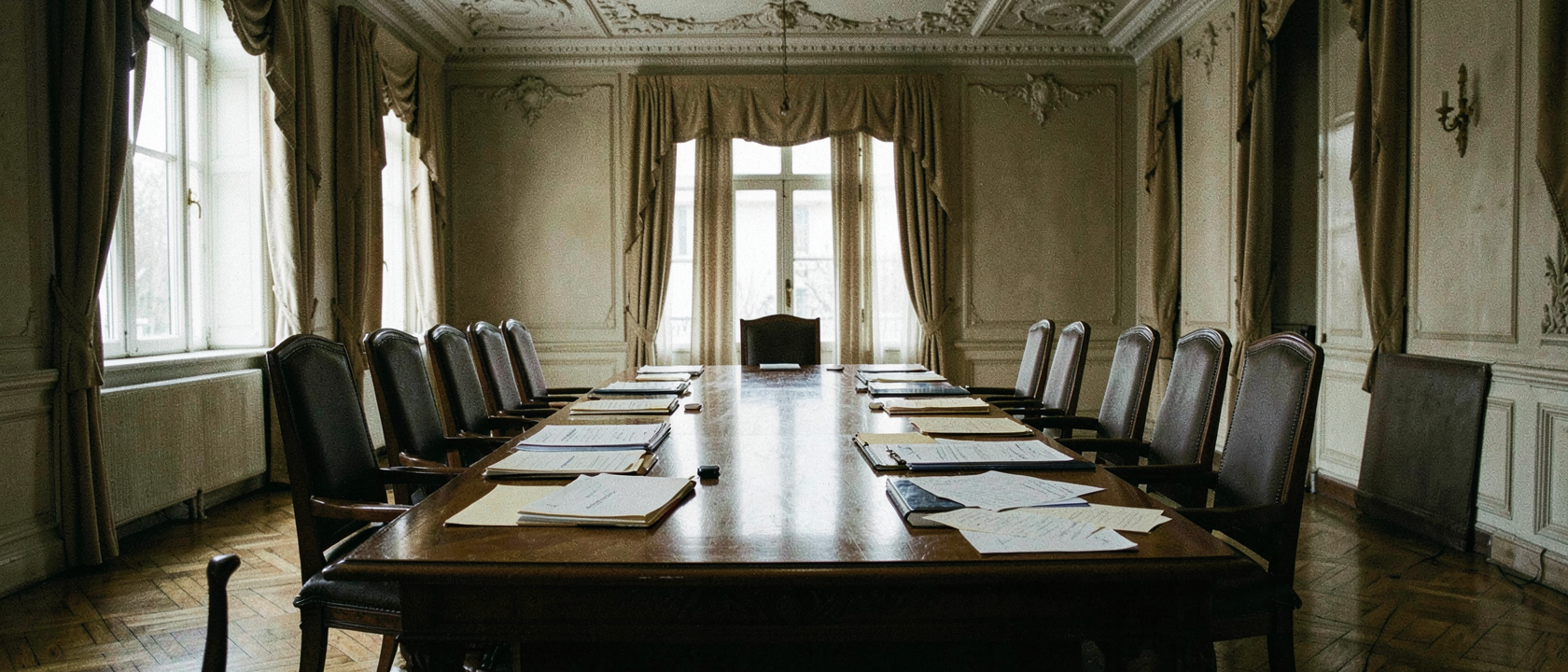
A Photograph Before the Explanation
Four men sit around a table at the Château du Stuyvenberg (also spelled Stuyvenbergh), a residence of the Belgian royal family in Laeken, outside Brussels. The record dates the photograph to December 9, 1993. The published caption names them from left: Russian Foreign Minister Andrey Kozyrev, Defense Minister Pavel Grachev, President Boris Yeltsin, and NATO Secretary General Manfred Woerner. The image anchors a collection of declassified material released on April 4, 2024. It places four named men in one room, on one morning. Nothing more is attached to it yet.
The Briefing Book
That collection is Briefing Book #855, “The Short-lived NATO-Russia Honeymoon,” edited by Svetlana Savranskaya and Thomas Blanton and published by the National Security Archive at George Washington University on April 4, 2024. A briefing book, in Archive practice, is a themed compilation of records obtained mainly through freedom-of-information requests, not a file built around one case. This one spans 1992 to 1995: memoranda of conversation (summary accounts written up after a meeting, not verbatim transcripts), a handwritten note, and reports on joint military exercises. It was timed to the 75th anniversary of the signing of the NATO Treaty in April 1949. The editors describe the period it covers as one of “high hopes.”
What the Chateau Meeting Record Shows
NATO’s own announcement at the time records that the Woerner-Yeltsin meeting began at 8:45 a.m. and ran about an hour, barely two years after the Soviet Union’s dissolution in December 1991. It put the alliance’s top civilian official across the table from Russia’s president, foreign minister, and defense minister at once. That combination is what makes it notable. The announcement gives a time, a length, a venue, and a guest list. It says nothing about what the four people discussed or decided.
The Rest of the Paper Trail
The briefing book holds other items from the same years. A memorandum of conversation dated February 25, 1992, records Woerner’s first visit to newly independent Russia, meeting Ruslan Khasbulatov, Speaker of the Russian Supreme Soviet; Woerner describes a security space “from the Urals to the Atlantic,” built on three pillars, the Helsinki process, the European economic community, and NATO. It is held at the State Archive of the Russian Federation under Fond 10026, Opis 5, delo 453, the Russian archive’s own folder-inventory-file numbers. A second record, Fond 10100, Opis 3, delo 5, shows U.S. Secretary of Defense William Perry discussing NATO’s Partnership for Peace program with Russian official Vladimir Lukin, who agrees on substance but flags the optics of “selling it” at home. A handwritten note from Deputy Secretary of State Strobe Talbott to Perry, dated October 27, 1995, cites a “breakthrough” reached with Grachev. Separate reports place Grachev inside joint U.S.-Russian military exercises.
Not an Investigation
None of this is an inquiry with a verdict. The Archive’s job was to gather these records and publish them with historical context; it reached no finding about what any single meeting produced. “High hopes” is the editors’ framing, written around the documents, not a conclusion found inside them. A separate kind of reading exists too: the Russian state outlet Sputnik, writing on April 6, 2024, argued that the release shows a contrast between Woerner’s assurances on non-interference in Russia’s internal affairs and NATO’s later conduct. That is an interpretation offered two days after publication, not a statement in the briefing book itself.
What the Paper Doesn’t Say
Set against the photograph and the two dated memoranda, the gaps are specific. The December 9, 1993 meeting has a time and a duration, but no memorandum of conversation in the release, nothing recording what the four men actually discussed. The “breakthrough” in Talbott’s 1995 note is named, not described. No exercise involving Grachev is identified by name or date. The material made available does not state how many documents the full briefing book contains beyond the ones it quotes directly. Each absence is a fact about the paperwork, not a fact about what the paperwork once held.
The Ordinary Explanation, and Where It Runs Out
There is an ordinary reason much of this is thin. Memoranda of conversation are summaries prepared for internal use, not transcripts, and they routinely leave out what a later reader wants to know. Supporting material tends to stay with the agency that produced it, State, Defense, or the Russian Foreign Ministry, rather than traveling into a compiler’s file decades on. Exercise reports get filed under a unit’s own designation, not folded into diplomatic records. That explains missing names, dates, and exercise identifiers. It does not explain why the most photographed meeting in the collection, chosen as the book’s anchor image, has no memorandum of conversation at all, when a lesser meeting a year earlier was written up in enough detail to quote Woerner’s own words.
Three Years, Framed as Brief
Read by date, the collection runs from February 1992 to October 1995. Its own title calls the period “short-lived,” and the editors note that cooperation returned later, briefly, after the September 2001 attacks, when Russia helped move U.S. and NATO forces through its territory toward Afghanistan. No document in the release names a date when the 1992-93 warmth cooled. The decline is not even clean: the last dated item in the set, Talbott’s note from October 1995, still describes a “breakthrough” with Grachev. The record supports a period the Archive calls brief. It does not supply the moment that brief stopped being an accurate word for it.
What the Photograph Confirms
What survives from December 9, 1993, is a time, a place, a guest list, and a photograph. The photograph needs no interpretation to do its job: four named men sat down together at a Belgian royal residence for about an hour, barely two years after the state two of them represented had ceased to exist in its old form. The briefing book confirms that contact happened at the highest level available to both sides. It confirms nothing about what passed between them. That is where the record stops.