
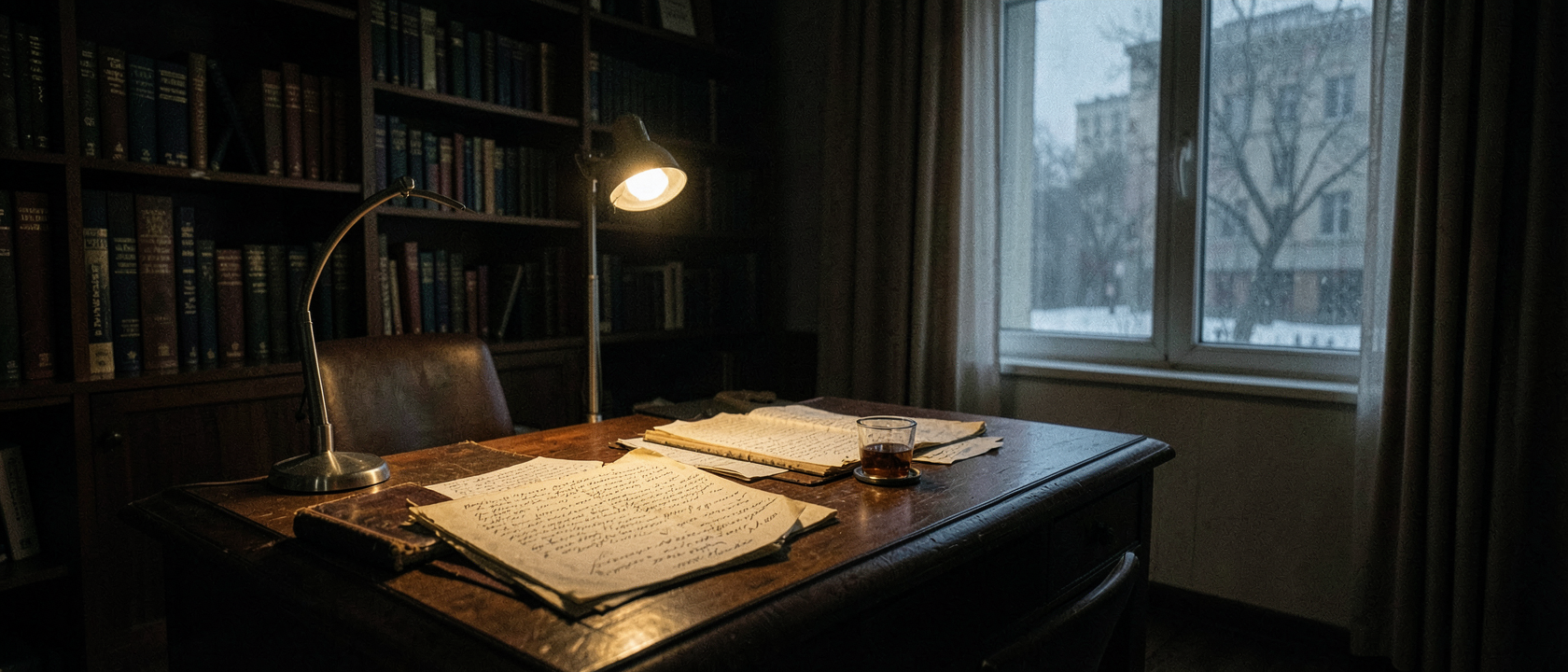
A diary written in real time doesn’t know how the story will end. That is what separates Anatoly Chernyaev’s 1982 notebook from most of what has been written about the Soviet collapse since: it was composed without knowing any of it was coming.
A Private Notebook Becomes a Public Document
Chernyaev began keeping his diary systematically in 1972, a decade before the entries discussed here. In 2004 he donated the handwritten originals, along with typed transcriptions made by his partner, Lyudmila Pavlovna Rudakova, to the National Security Archive at George Washington University, specifically to keep the record accessible regardless of political conditions in Russia.
The Archive has released the diary in annual English installments since then: 1972 in 2012, 1973 in 2013, then 1978 through 1981 across 2018 to 2021. The 1982 volume, translated by Anna Melyakova, followed on May 25, 2022, which the Archive marked as Chernyaev’s 101st birth anniversary. That date carries a small, unresolved wrinkle: the Archive’s own material gives his birth as May 25, 1921, while Wikipedia, Wikidata, TASS, and the Gorbachev Foundation give May 26. No source explains the gap, and nothing here resolves it either. Later installments, covering 1983 and 1984, appeared in 2023 and 2024.
In 1982, Chernyaev was deputy director of the Central Committee’s International Department, the body that managed Soviet relations with foreign Communist parties, serving under its longtime head, Boris Ponomarev. He became Mikhail Gorbachev’s foreign policy adviser in March 1986, a post he held through the Soviet Union’s dissolution in December 1991. He died in Moscow on March 12, 2017, at 95.
A Year Logged in Order
Read in sequence, the 1982 pages describe a year of visible wear. A Central Committee plenum held January 11 to 13 dealt with fallout from a December 30 resolution criticizing the Italian Communist Party’s response to martial law in Poland; Chernyaev records the resulting rupture with Italian leader Enrico Berlinguer. In February, Mikhail Suslov, the party’s chief ideologist, died. Chernyaev notes that Suslov’s influential post passed to Konstantin Chernenko rather than to his own boss, Ponomarev, apparently to Ponomarev’s disappointment.
Later entries describe Leonid Brezhnev nearly collapsing during an accident at a factory in Tashkent and having to be carried off a plane, and separately being unable to read a speech printed in large type during a visit to Baku. In August, Nikolai Inozemtsev, head of the Institute of World Economy and International Relations, died of a heart attack. The diary also records reports of corruption around Brezhnev’s family, naming son-in-law Dmitry Churbanov. Brezhnev himself died on November 10, 1982, and the Politburo chose Yury Andropov over Chernenko as his successor.
A Program Drafted Within Days
In the weeks around Brezhnev’s death, Chernyaev wrote out, in his own diary, a 15-point reform “program” addressed to whoever would take over: withdrawal from Afghanistan, removal of SS-20 missiles from Europe, and curbs on the military-industrial complex. He notes that Georgy Arbatov, head of the Institute for U.S. and Canada Studies, had drawn up a similar program independently at roughly the same time. On the succession question itself, Chernyaev set down his own calculation: if Andropov took over, he wrote, change might follow; if Chernenko did, it probably would not.
The diary records only that Chernyaev wrote this document. It does not record what became of it afterward.
How the Archive Frames It Now
The National Security Archive quotes historian David Hoffman calling the diary “irreplaceable” and “one of the great internal records of the Gorbachev years.” The Archive’s own introduction goes further, suggesting the 1982 entries show the informal emergence of the network that would become Gorbachev’s “brain trust.” That is the Archive’s interpretation, offered decades after the fact, not a description the diary gives of itself. Chernyaev’s own retrospective line, added later, is more modest: he called 1982 “the run up to perestroika.”
What the Pages Don’t Resolve
Three things the diary does not establish. It does not say whether the 15-point program ever reached Andropov, or whether he ever saw it. It does not establish any direct link between Chernyaev’s and Arbatov’s parallel 1982 drafts and the policies Gorbachev’s government actually pursued years later; the overlap in subject matter is visible on the page, a causal chain is not. And it never reconciles Chernyaev’s optimism about Andropov, recorded in late 1982, with the crackdowns Andropov launched the following year. The diary simply moves on to other things. The originals remain at the National Security Archive at George Washington University, alongside the rest of the Chernyaev series.